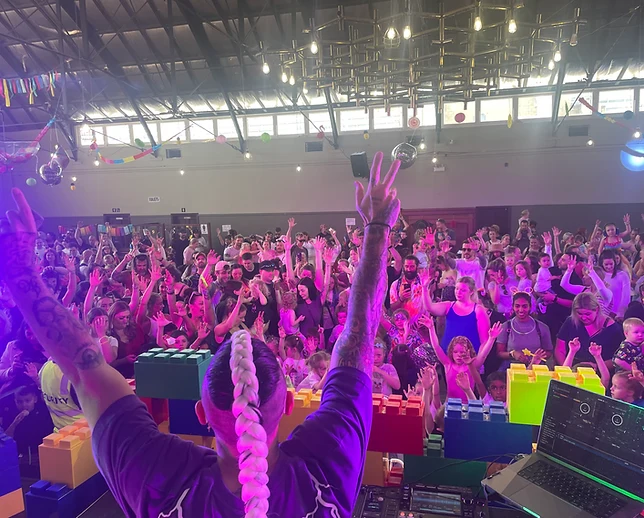
A rave for toddlers sounds like a joke until you look at the business behind it. Australian DJ and producer Lenny Pearce is bringing his Toddler Rave World Tour to St. Petersburg’s Mahaffey Theater on November 12, with the venue billing the show as a family dance-party experience built around electronic remixes of children’s songs.
Axios Tampa Bay highlighted the local date on September 29, while the Mahaffey Theater’s own event page confirms the booking and describes Pearce as a viral producer, DJ, father and pioneer of Toddler Techno. The venue says the tour follows sold-out runs across Australia, Asia, the Middle East, the United Kingdom and North America.
That makes this more than a funny headline. Pearce has created a new use case for dance music: parents who still like electronic music but now need an experience designed around children, earlier hours and family logistics. It is the same basic strategy promoters use in every niche — identify an underserved audience, redesign the experience around its constraints and give it a clear identity.
The hospitality angle is just as interesting. A 6 p.m. family event creates different food, beverage, staffing, security and arrival patterns than a midnight club night. The audience may spend differently, but it also opens revenue to people who would never attend a traditional late-night dance event.
THE DJ HANGOUT READ: the smartest part is not the nursery-rhyme remix. It is the audience design. A promoter found a demographic, built the programming around their real life and turned a social-media idea into a touring product.
THE SMART PART IS AUDIENCE DESIGN
The most important idea behind Toddler Techno is not the nursery-rhyme remix. It is market segmentation. Pearce identified parents who still enjoy electronic music but whose schedules and entertainment choices changed after having children, then designed a product around those constraints.
That means earlier hours, family-oriented logistics and a venue experience that is different from a midnight club night. Those differences can also create opportunity: an early show can activate a room at a time that might otherwise be dark and reach customers who would never attend traditional nightlife.
FROM VIRAL IDEA TO TOURING PRODUCT
Social clips can create curiosity, but touring is a harder test. A durable concept needs people to buy tickets, enjoy the experience, recommend it and return. That is where novelty becomes a business model.
THE DJ HANGOUT READ
Electronic music does not have to exist only at 1 a.m. The same culture can be adapted to theaters, daytime events and families when the experience is designed honestly for the audience.
THE LOCAL DETAILS
The Mahaffey Theater lists the St. Petersburg performance for Thursday, November 12 at 6 p.m. The earlier start time is part of the product design: this is not a nightclub trying to admit children; it is a family show using electronic-music language.
Axios reported that the concept grew from Pearce’s remixes of children’s songs and a social audience that translated into touring demand. The venue describes the tour as following sold-out runs across multiple international markets.
WHAT VENUES CAN LEARN
A family electronic event changes the operating model. Arrival is earlier, the audience mix is different, concessions can change, noise expectations are different and the show can activate a theater at a time when a traditional club event would not even have opened its doors.
That is why the idea is bigger than a novelty. It shows how electronic music can be packaged around a specific demographic without pretending that demographic behaves like a late-night club crowd.
The concept opens electronic music to a family audience and demonstrates how strong audience design can create a new touring category.
The novelty will only last if the experience is genuinely good for both children and parents.