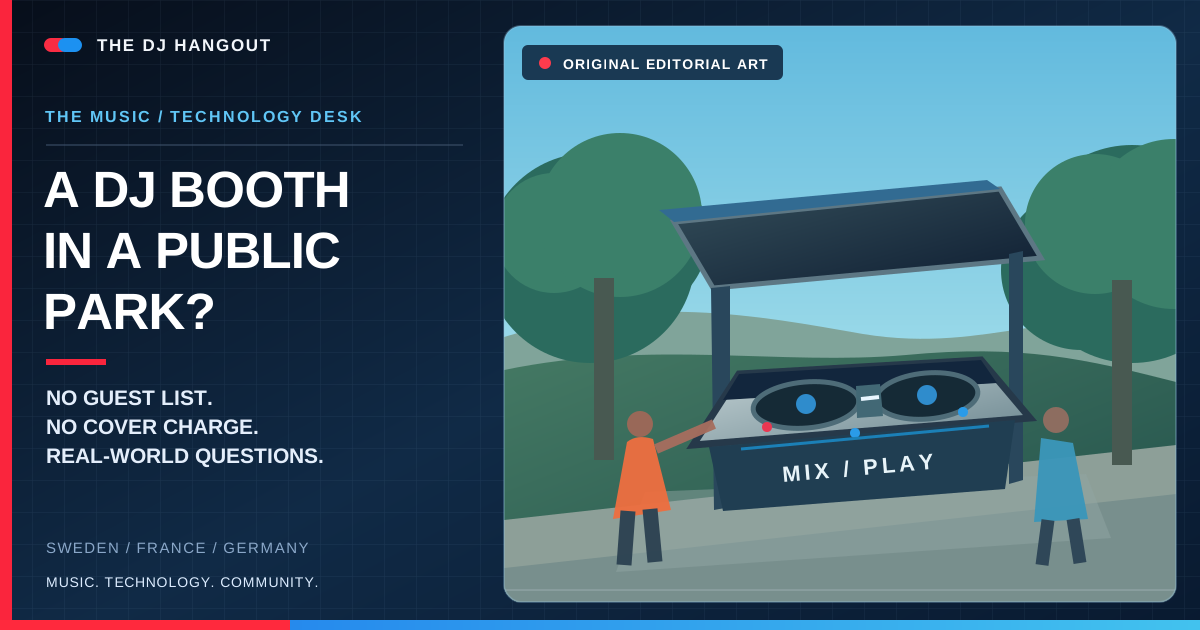
Imagine walking through your local park, past the basketball court and the guy doing something heroic with a pull-up bar, and finding a DJ booth.
No nightclub door staff. No guest list. No promoter demanding that you sell fifty tickets before they will consider your set. Just a piece of public equipment that invites you to experiment with music.
It sounds like something an optimistic DJ invented after one too many late nights. But outdoor public DJ stations are real. And they have been installed in actual community spaces, not merely drawn up for a technology pitch deck.
The bigger questions are more interesting than the novelty. Who makes them? Where have they worked? Who pays for them? How loud can they get? What happens when the hardware meets weather, a skatepark crowd and the occasional person who mistakes vandalism for creativity?
We tracked down manufacturer documentation and real-world case studies to separate the technology from the hype.
WHAT IS A PUBLIC DJ BOOTH, EXACTLY?
A documented example is the Fono Interactive DJ Booth from outdoor recreation equipment manufacturer Lappset. Instead of asking users to bring a professional mixer, turntables and a flight case, Fono is designed as a rugged, fixed outdoor station.
Lappset describes an interface that uses smartphones placed on sound-amplifying pads, with controls to mix music and experiment with effects. Its published documentation identifies filter, loop, scratch, delay and crossfader functions. The goal is not to recreate the entire technical environment of a festival booth. It is to make the first encounter with hands-on mixing straightforward.
That distinction matters. A park booth is not a club-standard setup with the flexibility, monitoring and sound system a professional DJ expects. It is closer to an interactive music playground: approachable enough for a curious beginner, but recognizable enough to make the principles of mixing feel real.
And if someone spends twenty minutes discovering that two songs can sound awful together, congratulations. They have learned one of the most important lessons in DJing before ever buying a USB stick.
SWEDEN: THE DJ BOOTH THAT DREW A CROWD
One real example is Gröningen, a waterfront recreation area in Helsingborg, Sweden. Lappset's published case study describes a Fono installed near an outdoor gym, basketball court and skatepark. The company's account cites the city's landscape architect, Josett Dahlin, who described significant interest from younger visitors as well as adults and older residents.
According to that case study, the city initially borrowed the station over a summer and then kept it after favorable reception. It also describes a visiting gymnastics group of roughly seventy girls using the booth as part of a dance routine. These are manufacturer-reported observations, not independent attendance figures—but they are concrete examples of what this sort of equipment can attract.
The lesson for a city recreation manager is that a music feature can serve as social infrastructure. It gives people a reason to gather and participate rather than simply walk through a public area.
FRANCE: A REAL PARK, NOT A RENDERING
At Parc de l'Île aux Planches in Le Mans, France, Lappset identifies a public Fono installation dating to 2019. The manufacturer's project page describes the booth as an interactive feature intended to turn a public park into a place for music and social connection.
That is a real named place and a real documented installation. It is not proof that every visitor learned to beatmatch, and we found no independently published figure for how many new DJs it created. But it demonstrates that this concept has been installed outside conventional nightlife venues.
For young people who have seen DJs only behind elevated stages or online streams, that change in access is the central idea: the technology is no longer something that only appears behind a velvet rope.
DORTMUND: UNDER A HIGHWAY BRIDGE, ON PURPOSE
In Dortmund, Germany, a Fono booth became part of You Point at Phoenix Lake, a youth recreation site opened in 2019 beneath a highway bridge. Lappset describes an approximately 5,000-square-meter space with sport and activity areas, including parkour equipment and the music station.
The manufacturer reports that more than five hundred young people took part in planning the broader youth area. That is not five hundred recorded DJs; it is evidence of youth participation in the site design. The distinction matters.
The city was not trying to establish a second Ibiza underneath the B236. It was providing a dedicated public place for young people to meet, move around and use music technology. That's a more grounded and more achievable goal than promising to discover the next superstar DJ on Tuesday afternoon.
MAGDEBURG: WHEN PUBLIC MUSIC MEETS PUBLIC MAINTENANCE
Now for the part the glossy product brochure cannot turn into a confetti drop.
A documented Fono installation in Magdeburg, Germany, encountered vandalism. Lappset's local case study describes graffiti and damage to the station, followed by the delivery of replacement parts and repairs that returned the equipment to operation.
The same account addresses neighborhood noise: residents reportedly appreciated that the music level was limited and that the station switched off automatically at 10 p.m. These details come from the manufacturer's case study and quoted local stakeholders; they are not a universal guarantee that every installation will have identical controls.
A working public music station is not just a piece of gear. It is a maintenance schedule, a sound policy, a public-space decision and a budget line. Somebody has to inspect it after the weekend. Somebody has to order replacement parts. And somebody has to take the phone call when a neighbor decides the park has been playing the same song for forty-five minutes.
WHO ACTUALLY PAYS FOR ONE?
Lappset publishes technical specifications and offers products in different configurations, including roofed and unroofed stations. Its product page lists dimensions and mounting information, along with warranty categories that distinguish structural components from electronics. That does not tell us the installed cost of a specific municipal project.
We could not verify a universal price for purchasing, delivering and operating one of these installations. Quoting a single number as if it applied to every park would be misleading. The real budget varies by equipment configuration, ground preparation, installation, local regulations, utilities or power design where applicable, servicing, insurance and potential replacement parts.
If you are a city planner, campus manager, resort operator or nightlife-district developer, the useful questions start with the total cost over several years, not just the price on a vendor proposal. Ask who owns the equipment, who maintains it, how audio limits are enforced, what accessibility requirements apply, and whether the music use requires additional licensing arrangements in your jurisdiction.
For a venue operator, the equipment itself may not be a revenue center. Its value could be participation, community goodwill, a reason to visit, or an introduction to music programming. Those are possibilities to evaluate—not financial returns we can responsibly promise without data.
COULD A PARK BOOTH CREATE THE NEXT GREAT DJ?
Possibly. But the honest answer is that there is no published proof here that a particular Fono installation launched a famous DJ's career.
The credible argument is more modest and more exciting: an approachable public mixing station can provide an inexpensive first encounter with music-making. That first encounter might lead someone to borrow a controller, learn production, join a school club, or practice until a small venue finally offers a Friday-night set.
The DJ industry is full of stories about expensive equipment, long hours of practice, empty rooms and the brutal economics of early bookings. The park booth doesn't eliminate any of that. It simply lets someone find out whether they love mixing before they have to spend money to find out.
And sometimes the most valuable thing you can give a young person isn't a career plan. It's a chance to play.
WHAT THE DJ HANGOUT THINKS
Public DJ stations won't replace professional DJs. A fixed park console is not going to handle a headlining festival set, a demanding nightclub sound system or the requests from a wedding party that has somehow decided to change musical genres every thirty seconds.
What it can do is make electronic music culture more visible, more physical and more inviting. The best installations also have to survive the unglamorous realities: scheduling, sound levels, durability, repairs, local interest and money.
In other words, the future of DJ culture might begin with an extraordinary piece of equipment in an ordinary park. But keeping it working takes more than a good drop.
EDITORIAL NOTE
This article documents the Lappset Fono product and named installations from manufacturer and project accounts. We have not independently identified the exact equipment shown in the Instagram Reel that inspired our separate video report; no claim here equates that unit with Fono. Reported community reactions are attributed to the manufacturer's case studies. Pricing, music-rights costs and measured long-term outcomes have not been independently verified.
Documented real installations in Sweden, France and Germany. Low barrier for newcomers; a participatory addition to public spaces; opportunities for community music discovery.
Capital and maintenance expenses are not standardized; vandalism and repairs are real; volume restrictions and licensing require site-specific policies. Career outcomes are not proven.
REPORTING SOURCES
Public reporting and primary references used to check this story. Analysis and illustrative examples are distinguished from disclosed earnings and private financial records.