It's 1:45 a.m. The DJ is finishing the last set, the staff is clearing the room, and the bar manager is staring at the register.
The sales total looks pretty good. The crowd was busy. Drinks were moving. Everybody worked hard.
Then somebody counts the beer.
Suddenly, the numbers are having a different kind of afterparty.
This is where venue technology becomes interesting. Not because a dashboard can look beautiful on an iPad, but because running a profitable bar means understanding what you purchased, what you sold, what you poured, and what you lost along the way.
For nightclub owners, venue operators, promoters who share in bar revenue, and anyone considering investing in nightlife, that distinction matters.
THE COSTS AREN'T GETTING ANY LIGHTER
The National Restaurant Association estimated in July 2026 that total expenses for an average restaurant increased approximately 36% between 2019 and 2026. The association also reported that 42% of operators said their restaurants were not profitable in 2025.
Those figures cover restaurants broadly. They are not nightclub-specific numbers, and it would be misleading to say that 42% of clubs were unprofitable. But the underlying cost pressure—labor, ingredients, utilities, occupancy, and payment-related expenses—will sound familiar to many bar owners.
The National Restaurant Association's September 22 economic outlook adds a timely warning: consumers are becoming more selective about discretionary spending even as operators face continued cost pressure. That does not tell us a particular nightclub's balance sheet, but it explains why finding avoidable waste matters more when raising prices is not an easy answer.
Operators who used to tolerate a certain amount of unexplained waste are increasingly being forced to ask how much they're actually losing and why.
The answer may involve technology. It may also involve staff training, system maintenance, portion control, a revised purchase order, or a more careful inventory process.
Usually, the smartest answer starts with measuring the problem.
A KEG IS NOT A MAGIC MACHINE THAT PRINTS PINTS
Consider a standard U.S. half-barrel keg. Its nominal volume is 15.5 gallons, or 1,984 fluid ounces. Divide that by a theoretical 16-ounce serving and you get 124 servings before accounting for foam, retained product, cleaning, transfers, glass-fill conventions, and normal operating waste.
That isn't a promise that 124 perfectly saleable pints will come out of every keg. It's simple volume arithmetic showing why an operator needs to understand the difference between theoretical yield and actual yield.
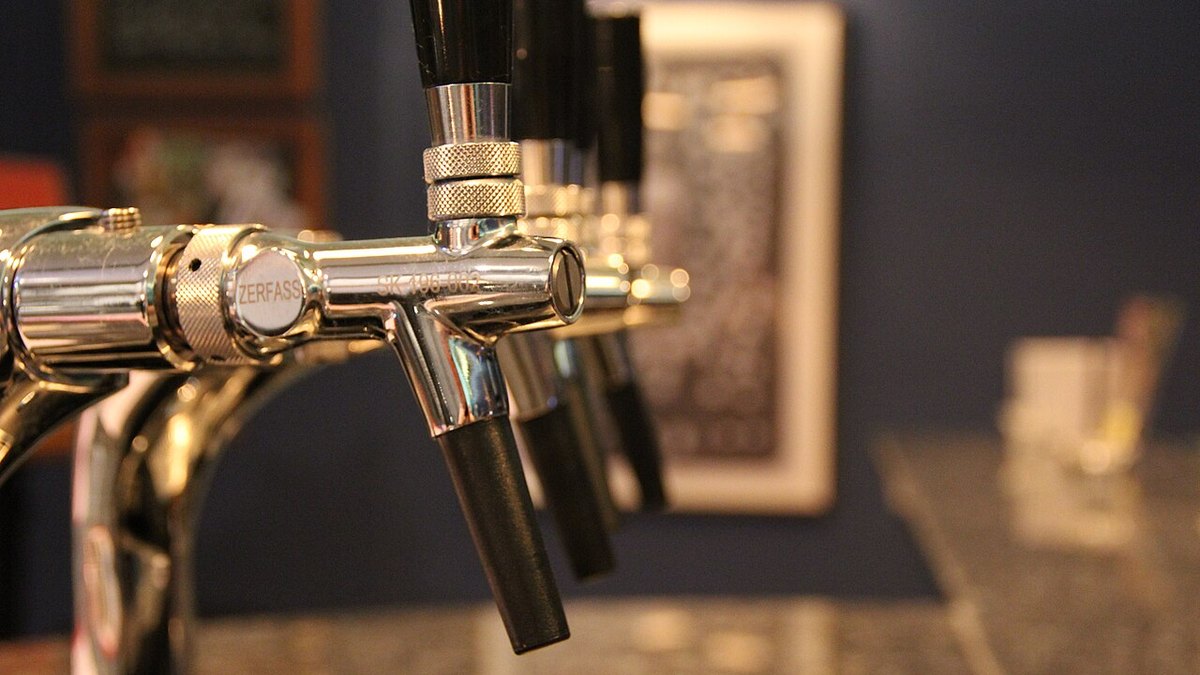
And draft-system maintenance matters. The Brewers Association's 2026 Draught Beer Quality Manual covers line cleaning, system design, gas balance, proper pouring, and sanitation. Its guidance connects equipment setup and serving practice with beer quality and consistency. The association also publishes a draft-line cleaning log recommending a two-week line-cleaning cycle and a visible record of the most recent cleaning. A venue manager can verify when the system was serviced before blaming the staff for excess foam or inconsistent pours.
A badly balanced line can produce excess foam. A poorly trained bartender may pour inconsistently. An inventory count may be wrong. A keg may be connected, changed, or documented at the wrong time. None of those scenarios automatically implies dishonest staff.
Before accusing anybody of stealing, make sure the numbers are right.
WHAT THE POS DOES—AND WHAT IT DOESN'T
The point-of-sale system is an important part of the picture. It records transactions, sale categories, discounts, voids, and other information depending on the configuration.
But a POS transaction doesn't measure what physically left the bottle or the tap. It can tell you that a particular drink was sold. It can't independently prove that the bartender poured the standard amount, that the keg was correctly calibrated, or that no drinks were entered under the wrong item.
Physical inventory counts, purchase invoices, recipe or portion standards, and waste logs provide the other side of the picture. Some operators add draft-flow monitoring or electronic pour-measurement systems.
Those devices can be useful, but they're not infallible. A sensor must be installed and maintained properly. A report needs to be reconciled against real deliveries and physical counts. And human judgment remains essential when the systems disagree.
There is no magical app that turns inaccurate inputs into accurate decisions.
LET'S DO A SIMPLE BAR MATH EXERCISE
Imagine an entirely hypothetical venue. It buys beer for one event, sets its menu price at $8 per serving, and records 110 paid servings from a particular keg during the night. That produces $880 in gross retail beer sales for those recorded servings, before taxes, refunds, and any other adjustments.
Suppose the manager's inventory model suggests the equivalent of 115 sale-size portions left the keg. The five-portion gap has a hypothetical retail menu value of $40.
Is that $40 stolen? No. That isn't what the calculation proves.
The discrepancy could come from foam, spillage, complimentary drinks, pours to the wrong size, poor calibration, stock-count errors, or an improper register entry. The actual economic loss may be different from $40, because retail value isn't the same as product cost or profit.
The calculation establishes a question worth investigating, not a verdict about an employee.
The next move is to check the underlying records, compare similar shifts, inspect the draft equipment, and talk with the team. If you discover an avoidable operating issue, fix the process and measure again.
That's what useful data looks like.
THE HUMAN COST OF A BAD SYSTEM
There is another reason to proceed carefully: people work in these rooms.
A bar manager who treats every discrepancy as evidence of theft can destroy morale, create conflict, and miss the technical or training issue that caused the numbers to diverge. A manager who ignores all discrepancies can lose control of costs and let bad processes continue.
The right approach is consistent procedures and fair documentation. Tell staff how pours, voids, comps, transfers, and breakage are supposed to be recorded. Give them working equipment and practical training. Apply the same rules across shifts.
Monitoring technologies may also raise privacy and workplace issues. Laws and employment arrangements differ, so any surveillance or tracking deployment deserves proper review rather than a blanket assumption that everything a device can record should be recorded.
The purpose is an operation that works better, not a nightclub where everybody feels as though they're on a crime reality show.
WHAT TO CHECK BEFORE SPENDING ON TECHNOLOGY
Start with a small audit. Establish beginning and ending inventory for a defined period, document deliveries and transfers, and compare the result against POS transactions and recorded waste. Separate draft beer, packaged products, spirits, and nonalcoholic drinks. Their economics and measurement methods aren't identical.
Identify the largest unexplained variance you can reliably measure. Then investigate ordinary causes: line condition, glass size, pour standards, recipe design, training, and recording procedures.
Only after you understand the problem should you compare vendors. Ask whether the proposed system integrates with your existing POS, whether equipment requires downtime for installation, what support costs after the first year, and how the vendor demonstrates accuracy.
A beautiful dashboard that creates two more hours of paperwork every Monday isn't automatically an efficiency upgrade.
And the bar's core mission still matters. Faster service, better-quality drinks, fair staff policies, and a satisfying guest experience are part of the return on any investment. Tracking every ounce isn't useful if guests stop coming back.
THE BOTTOM LINE

Bars and nightclubs operate on more than music and atmosphere. They're businesses with inventory, labor, utility bills, suppliers, licensing obligations, and narrow opportunities to correct mistakes after the night is over.
Good technology can illuminate what is happening between the storeroom and the register. It can't replace competent people or careful management, and it shouldn't be used as an excuse for unsupported accusations.
Measure what you can. Investigate what you can't explain. Fix the repeatable problems. Then get back to what people came for in the first place: an excellent night out.
Because the only thing a venue operator likes more than a busy bar is a busy bar with numbers that make sense in the morning.
Routine line cleaning, reconciled POS and inventory reviews help operators spot preventable problems.
Inventory variance is not evidence of theft; retail prices are not net profits.
REPORTING SOURCES
Public reporting and primary references used to check this story. Analysis and illustrative examples are distinguished from disclosed earnings and private financial records.